
Intestate Succession

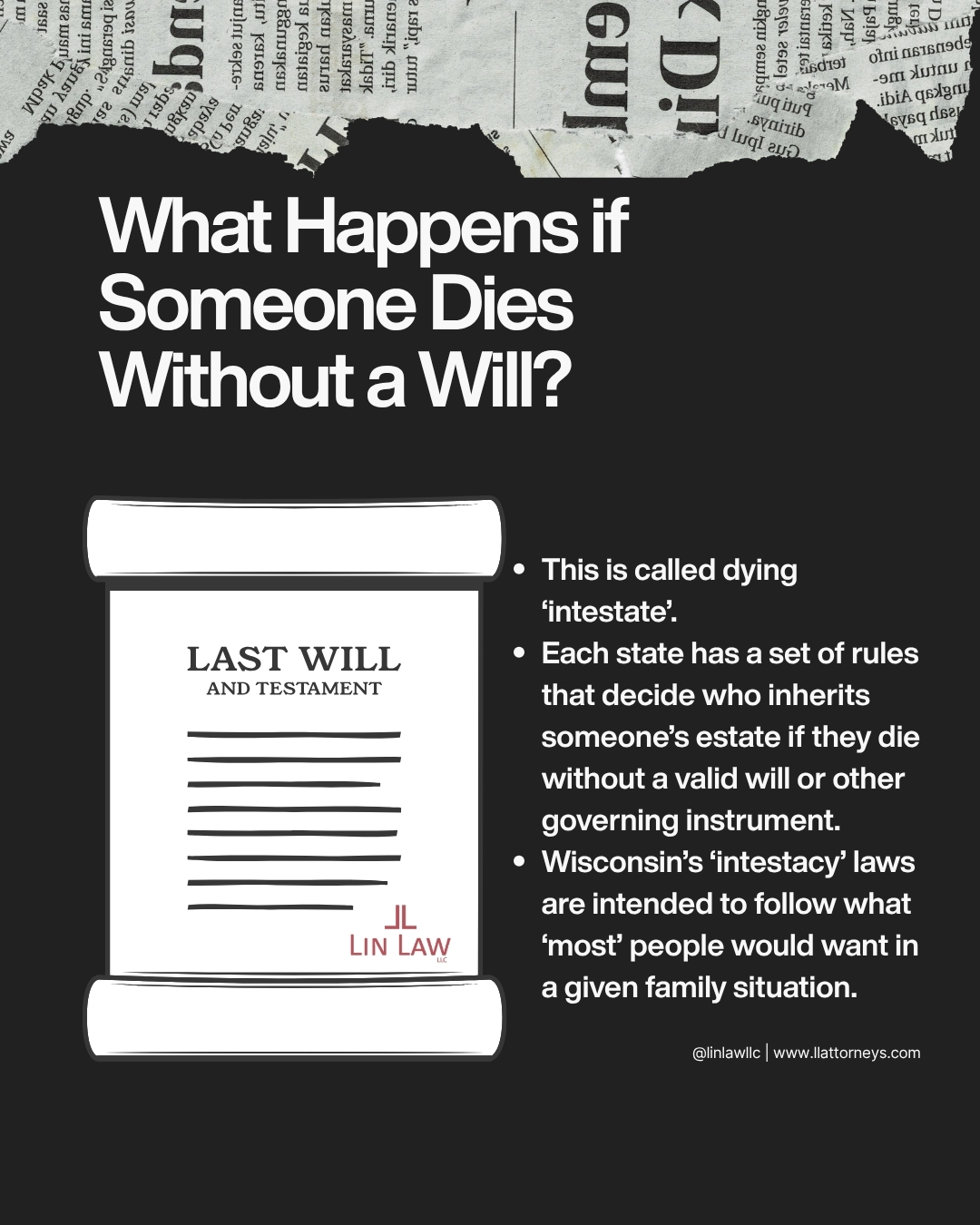
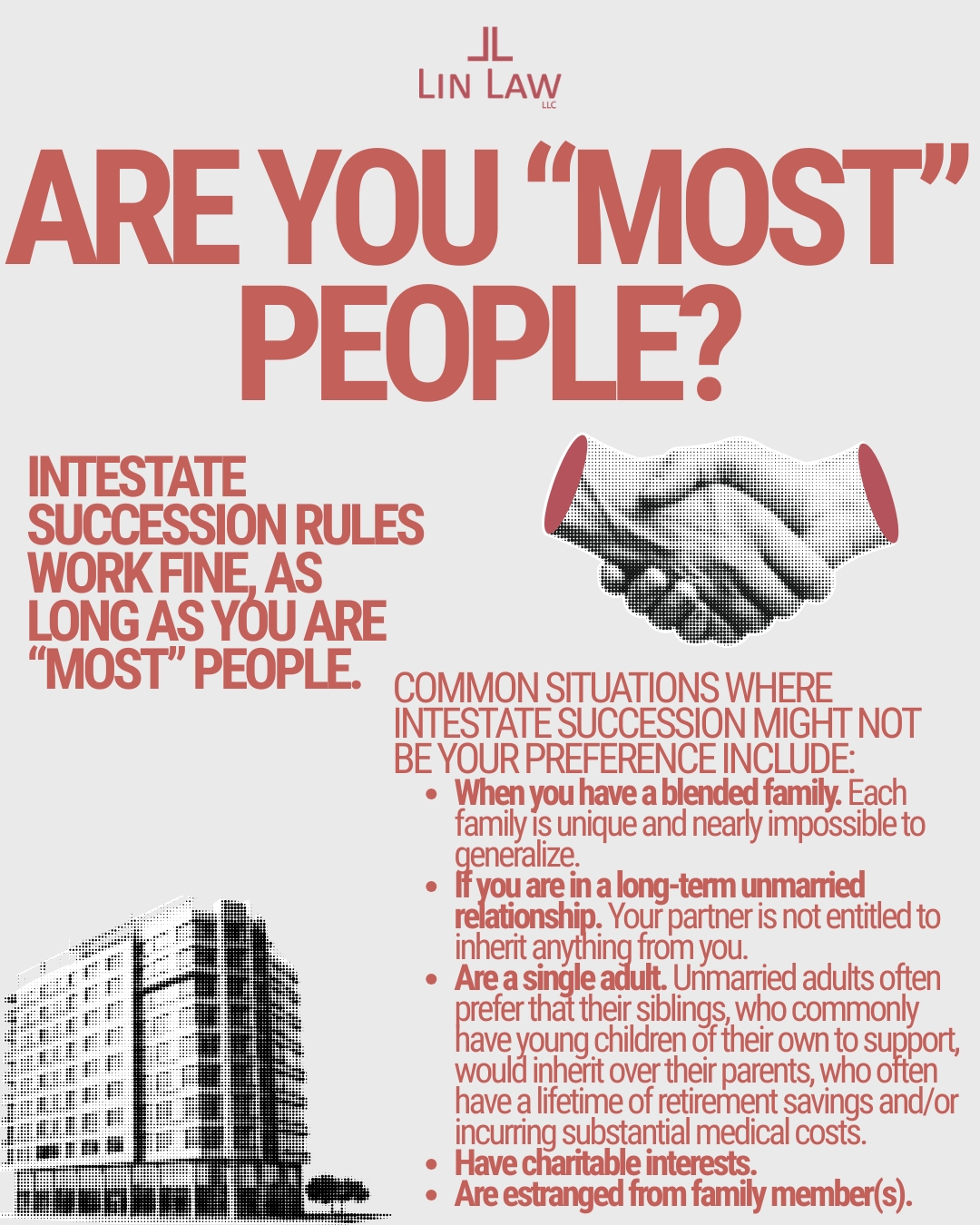
Have you ever wondered what happens if you die without a valid estate plan? In legal terms, dying without a plan in place is called intestacy. Each state has its own set of intestacy laws that determine who inherits your assets. While intestate rules may vary slightly from state to state, they are intended to mirror what most people would want based on given family circumstances.

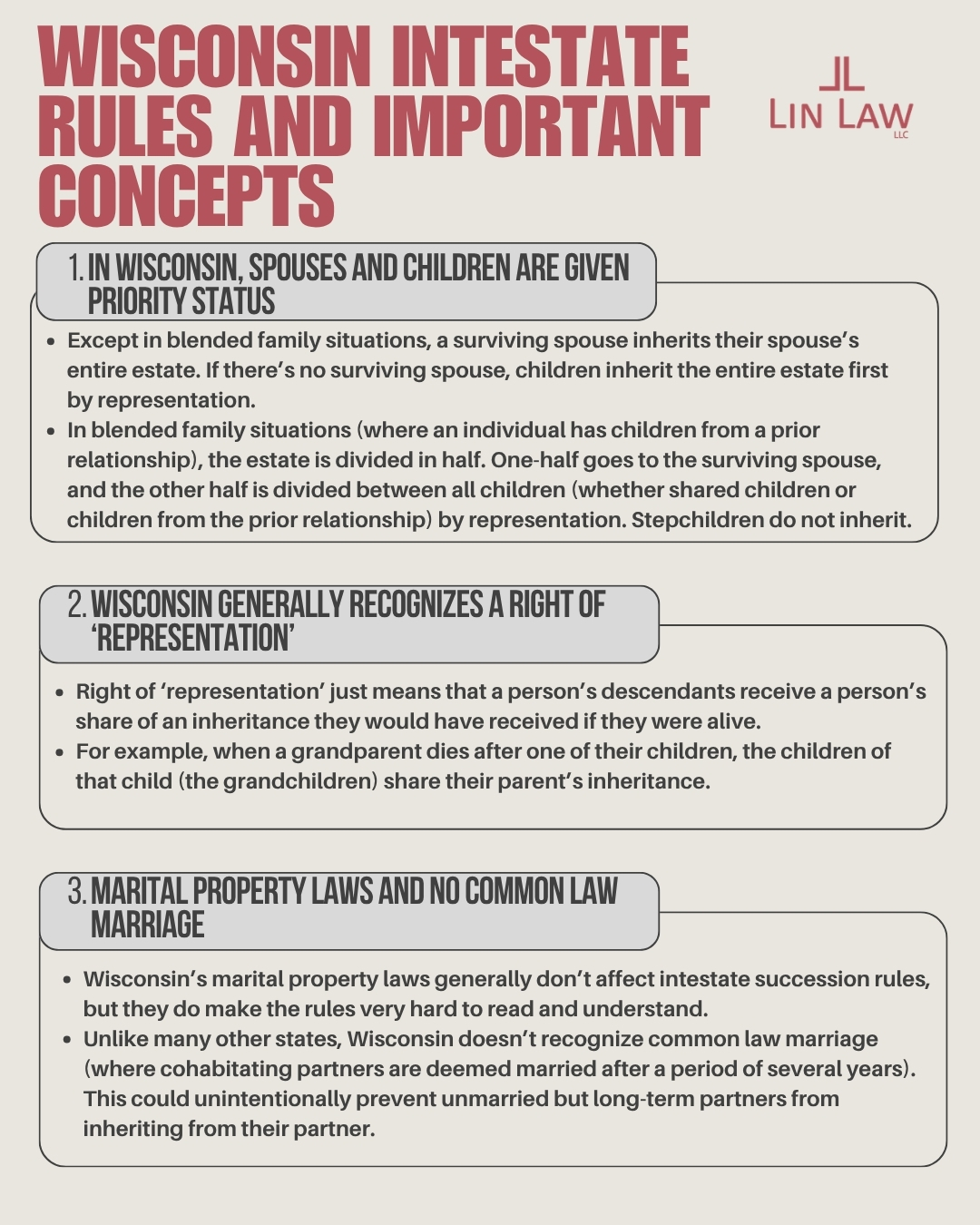
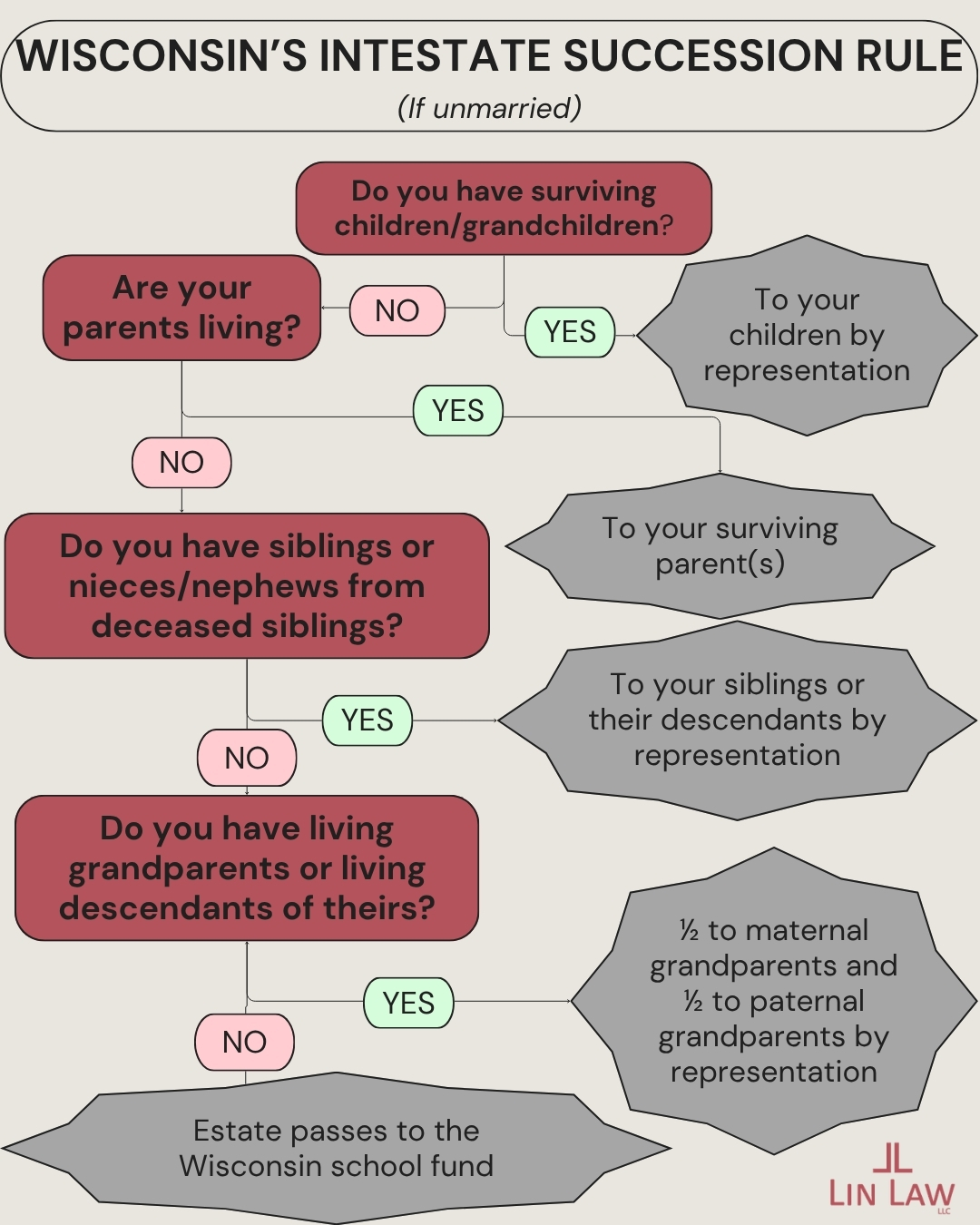
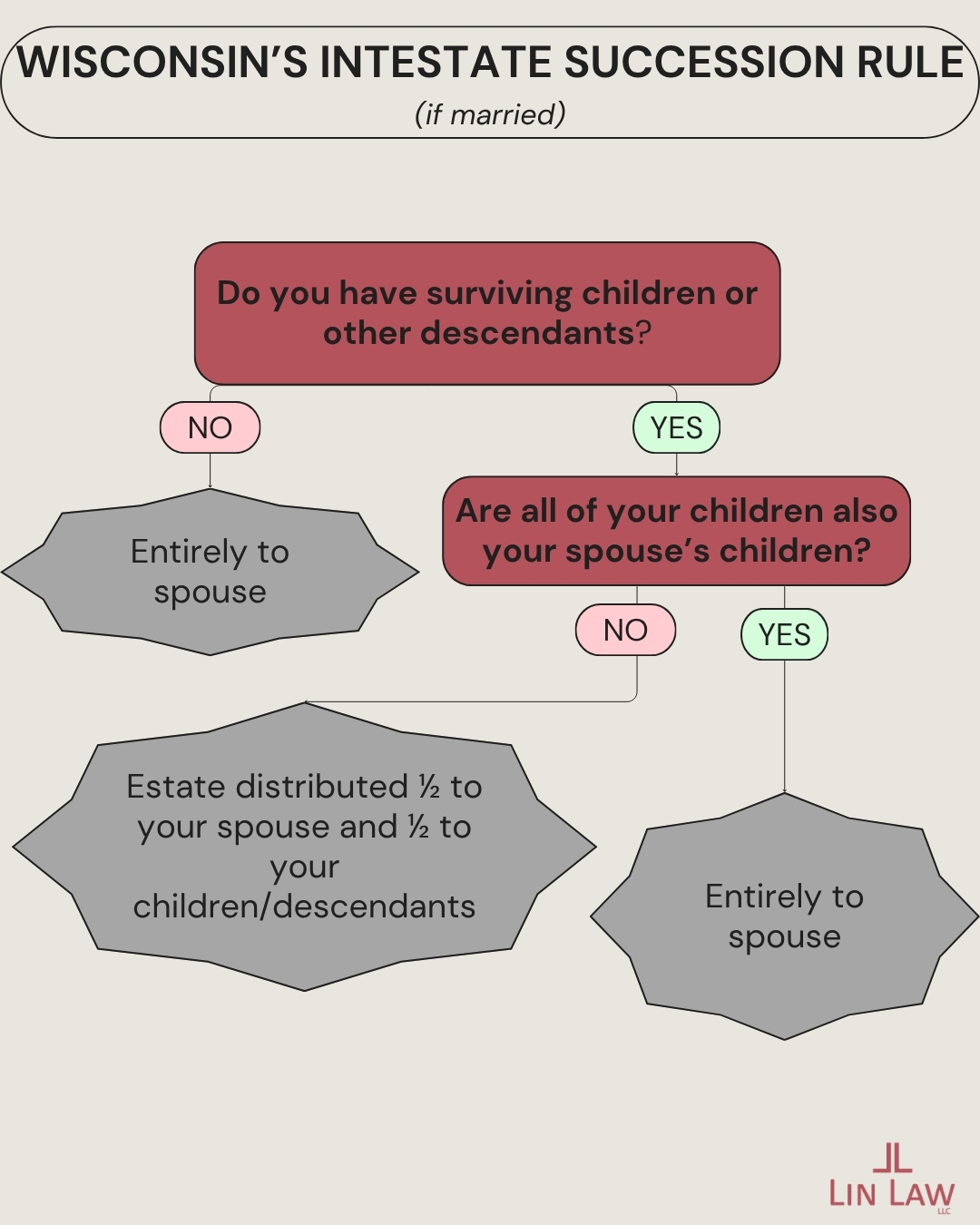
In Wisconsin, your spouse and children have priority status. If you are married and have no children, or if all of your children are shared with your spouse, your spouse inherits your entire estate. If you’re married but have children that aren’t shared with your spouse, then your spouse receives half your estate while your children share the other half equally by right of representation. If you’re unmarried but have children, your children inherit your entire estate equally by right of representation. If you’re unmarried with no children, then your next of kin inherit your estate.

Right of representation just means that a deceased person’s descendants share equally in the share that would have gone to that person had they been alive. For example, if your child dies before you but has surviving children of their own, then your child’s share is split equally between their children (your grandchildren).

It’s not uncommon to have different preferences than what “most” people would want, though. Some common examples are: (1) Blended family situations, which are near impossible to generalize; (2) Long-term relationships where partners choose not to get married but would prefer that their partner inherit their estate (Wisconsin law doesn’t recognize common law marriage); and (3) Early adulthood, where single young adults may prefer that their siblings, who may have young children, inherit instead of their parents, who may be empty nesters with a lifetime of retirement saving behind them.

Relying on intestate succession rules is just one reason to have a personalized estate plan created. Don’t leave your estate administration up to the state. Make your wishes known and protect your legacy with a clear estate plan unique to your family.
Disinheritance Clauses: Myth and Reality

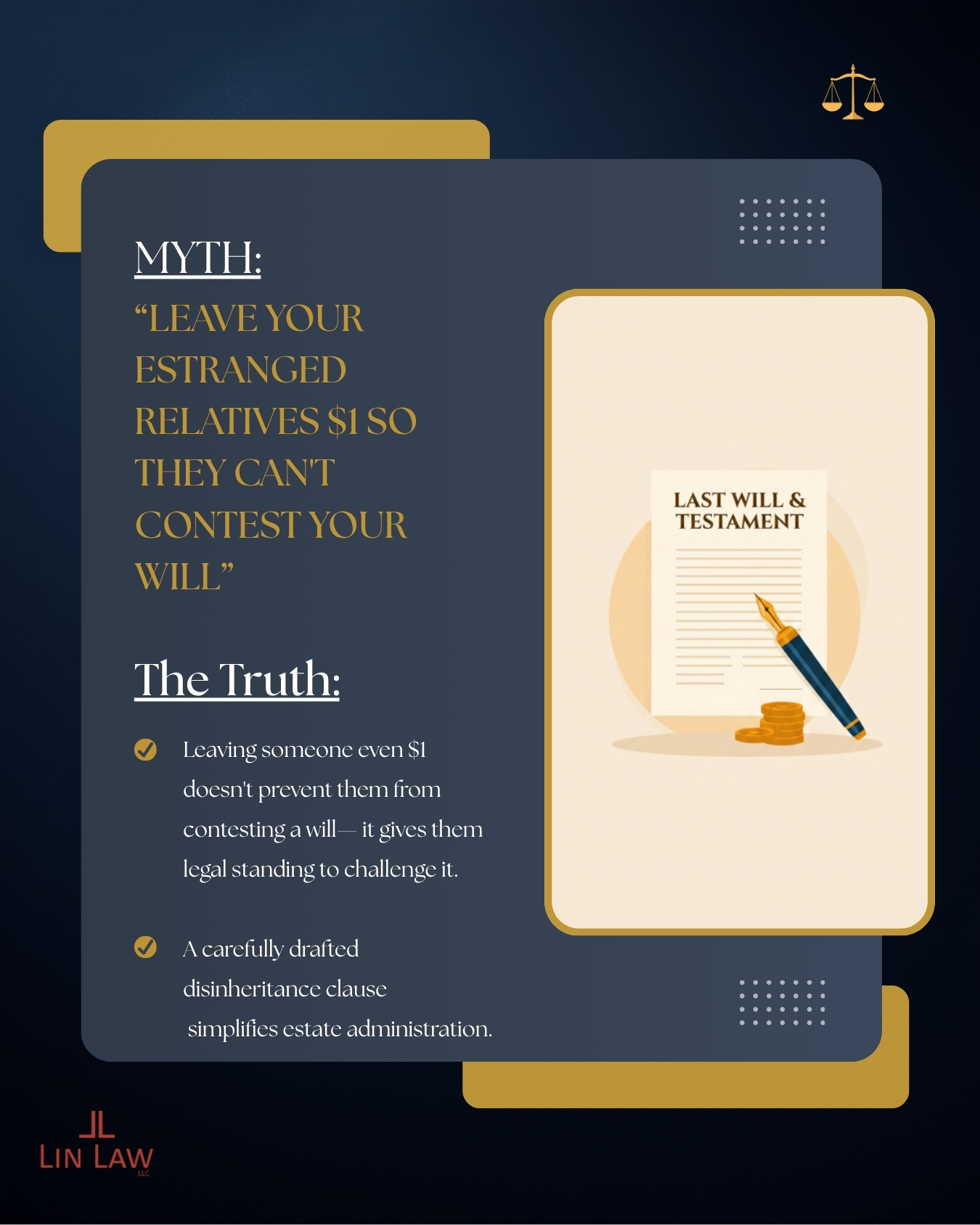
Myth: “Leave your estranged relatives $1 so they can’t contest your will.”

A common belief is that designating any portion of your estate to an estranged relative will legally prevent them from challenging your will. In reality, leaving someone anything in your will generally makes them an “interested party” in the eyes of the court, meaning they must be formally notified of the probate proceedings. This can inadvertently involve a disgruntled relative in your estate administration process, potentially leading to drama and confusion.

If your intention is to exclude someone from both inheriting any of your estate and from challenging your will, a carefully drafted disinheritance clause is, in most cases, the better approach. It clearly documents your wishes and helps avoid questions about whether the omission was accidental.

Disinheritance clauses aren’t just for estranged family members, either. They can also simplify estate administration in amicable situations as well, and help explain unequal distributions among family members. For example, a parent may have already provided extensive financial support or established separate planning—outside of a will or trust—for a child with special needs, making it appropriate for another child to inherit the estate. A thoughtfully-drafted disinheritance clause can clarify the reason for doing so. In such a case, the clause may include a phrase directed towards the disinherited child to show that the testator has made the decision “not for any lack of love or affection, but for reasons known to them.” Even if everyone agrees on who should inherit, clearly stating your intentions in your will can help make the probate process smoother.

Every family situation is different, which is why thoughtful estate planning is crucial. A properly drafted will can help ensure your wishes are carried out while minimizing unnecessary complications for your loved ones.

Beneficiary Designations (TOD/POD) vs. Revocable Trusts

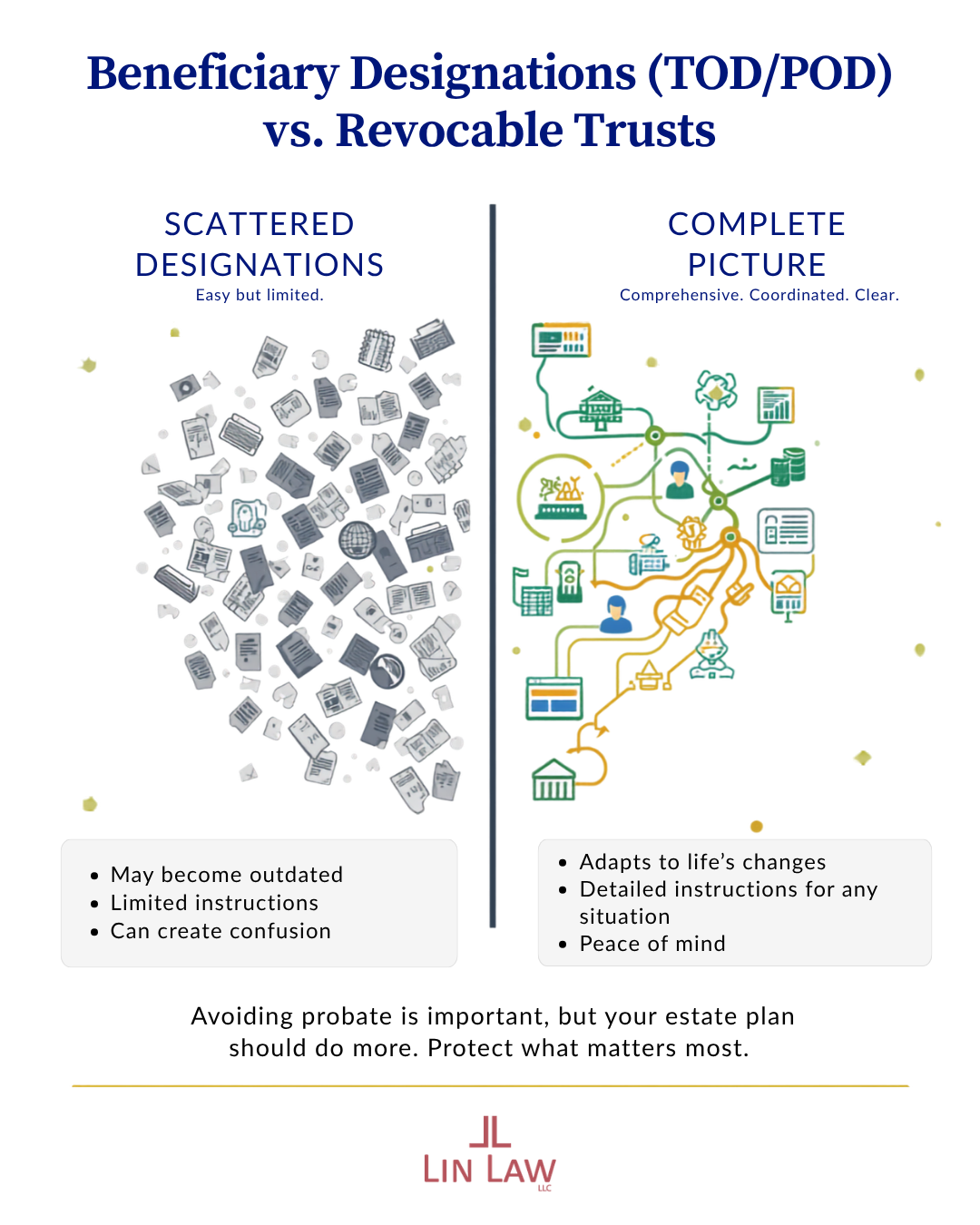
One of the most common misconceptions about estate planning is that adding beneficiary designations to your financial accounts will be enough to both avoid probate and have a comprehensive estate plan. However, while transfer-on-death (TOD) and payable-on-death (POD) designations can help pass assets directly to your heirs without probate, a clearly structured estate plan focuses on more efficiently managing assets and their distribution, since it takes into account unforeseen life changes that a TOD or POD designation does not account for. Avoiding probate alone should not be the only goal with respect to a complete estate plan.

This is where revocable trusts can provide significant advantages. A revocable trust enables your assets to be managed as a whole—and includes instructions for distributing them in the case of unexpected circumstances. Rather than relying on multiple beneficiary designations that may become outdated or create confusion, a revocable trust provides a clear roadmap with alternative steps to account for any life changes. Although beneficiary designations can be a useful tool, a revocable trust is ultimately a more effective solution to the various complexities of asset transfers and as part of a comprehensive estate plan.

Save your family from legal complications during an already stressful time by creating a comprehensive estate plan. A thoughtful estate plan today can provide peace of mind for you and your loved ones tomorrow. Prepare for the future now to minimize headaches for your family and ensure that your wishes are honored.

Guardianship Myth

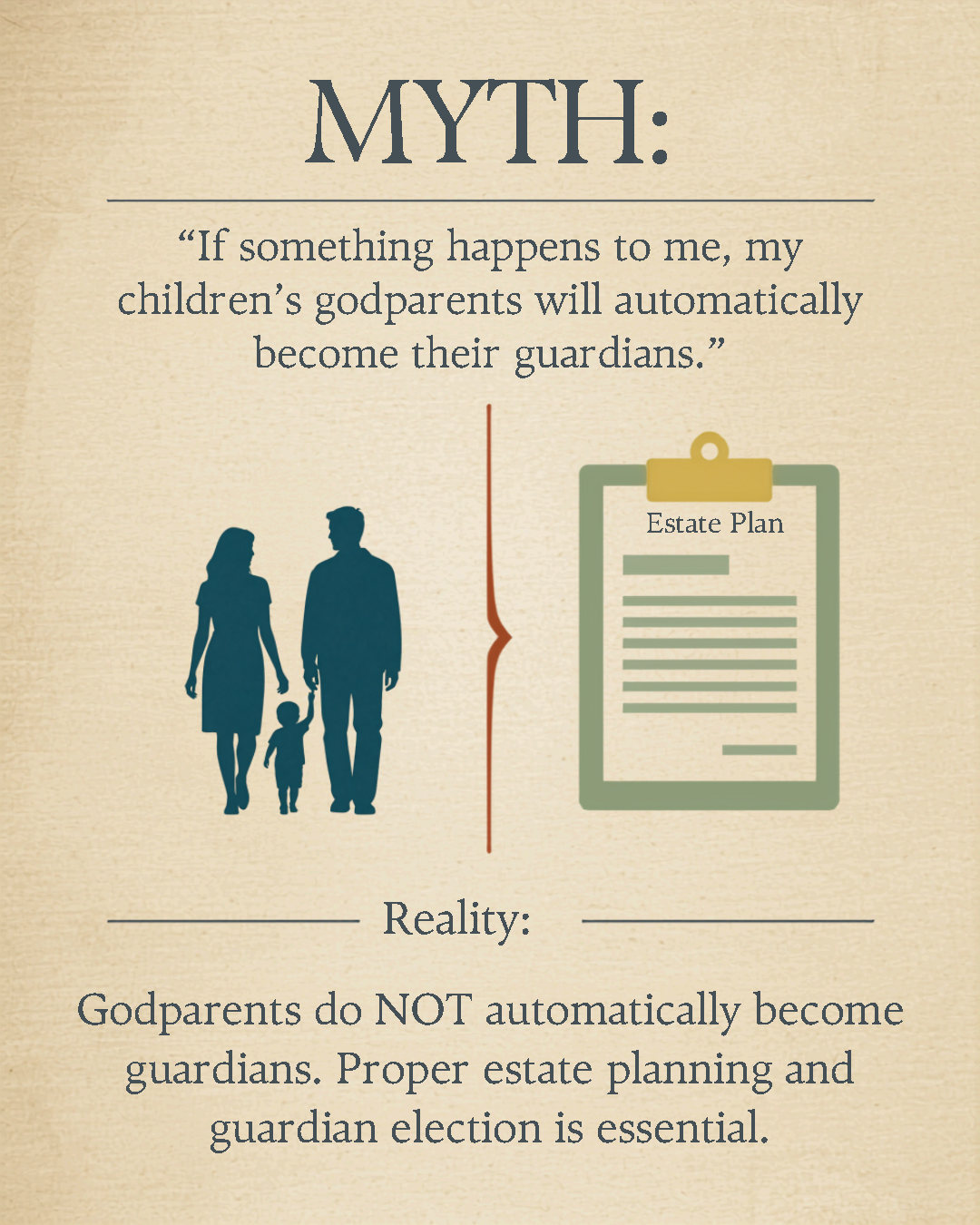
Myth: “If something happens to me, my child’s godparents will automatically raise them.”

Reality: Godparents do not automatically become guardians. The tradition of naming godparents in a baptismal record—or otherwise making a verbal promise—is not legally binding in a court of law. If legal guardians are not specifically named in your will, the court will appoint them for your minor children. This means a judge who does not know your family dynamic or values could potentially choose someone you would not want to raise your children. It could also cause complicated custody battles among your relatives.

Take action today by having important conversations with family members and close friends about serving as guardians for your children. Protect your children by electing guardians in your estate plan—the only way to ensure that your wishes regarding their care are respected. This simple legal step provides peace of mind and a safeguard for your family’s future.

To Port or Not: The Federal Estate and Gift Tax Exemption

Uncover the benefits of Portability in Trust and Estate Law with this informative article written by Attorney Evan Y. Lin for the State Bar of Wisconsin. Learn how leveraging portability can help you minimize estate tax liabilities and protect your family's financial legacy.
Read the full article here:  https://www.wisbar.org/NewsPublications/Pages/General-Article.aspx?ArticleID=30066

What is an Irrevocable Life Insurance Trust?

By Attorney Curtis A. Edwards

Irrevocable Life Insurance Trust (ILIT) is a powerful estate planning tool that can provide several benefits to individuals and their families. An ILIT is a trust that is designed primarily to own a life insurance policy. The policy proceeds are paid to the trust upon the death of the insured, and the trust distributes the funds according to the trust document. The trust is irrevocable, meaning that once it is created, the grantor cannot change its terms or reclaim the assets transferred to the trust.

ILITs can provide significant benefits to individuals and their families. One of the primary benefits is that they can help reduce estate taxes. When an individual passes away, their assets may be subject to estate taxes if they exceed the estate tax exemption amount. Life insurance proceeds are also included in an individual’s estate, so if the policy is owned by the insured, the life insurance proceeds may be subject to estate taxes. However, if the policy is owned by an ILIT, the proceeds are not included in the insured’s estate, and therefore not subject to estate taxes.

In addition to estate tax benefits, ILITs can provide a source of liquidity for the trust beneficiaries. Upon the death of the insured, the ILIT receives the life insurance proceeds, which can be used to pay estate taxes, debts, or other expenses. This allows the beneficiaries to inherit other assets without having to sell them to pay expenses.

In conclusion, an ILIT is an effective estate planning tool that can provide significant benefits to individuals and their families. An ILIT can help reduce or eliminate estate taxes and provide liquidity to a decedent’s beneficiaries, among other things. By understanding what an ILIT is and how it works, individuals can make informed decisions about their estate planning strategies.

If you have any questions or are interested in learning more about this topic, please contact Lin Law LLC at (920) 393-1190.

When Your Beneficiaries Could Receive An Inheritance – Which Distribution Method Is Best?

The method in which you choose to distribute a beneficiary’s inheritance upon your passing is an important part of the estate planning process. There are a variety of ways to do this, and you should consider the method that best meets your estate planning goals.

Distributed Outright  After all bills and expenses are paid, assets are divided and distributed to your beneficiary(ies) directly. This distribution method is an option for parents who have financially responsible adult children.

In Trust, Distributed Outright at a Certain Age, at Certain Ages, or Upon a Life Event  The assets that are held in trust for a beneficiary’s lifetime are distributed by a trustee in accordance with the trust’s provisions. Usually the provisions of a children’s trust or beneficiary’s trust provide that when the beneficiary attains a certain age (common age distribution choices are thirty (30) or thirty-five (35)), the trustee will distribute the assets of the trust outright to the beneficiary at the specified age, thus terminating the trust. Trust assets can also be distributed at multiple distribution ages. For example, the provisions of a trust can provide that the beneficiary shall receive one-third (1/3) of the trust assets at the age of twenty-five (25), one-third (1/3) at the age of thirty (30) and the residue of the trust outright at age thirty-five (35). A less common, but still useful option, would be to distribute the assets of a trust outright upon an event, such as graduating from college.

Asset Protection Trust  Another common distribution structure is an asset protection trust that is held and maintained for the lifetime of a beneficiary with no mandatory distributions of principal and income.  An asset protection trust can provide for the beneficiary to become co-trustee or sole trustee of his or her trust upon attaining a certain age. Upon the death of the beneficiary, unless the beneficiary exercises a valid power of appointment, the assets would continue to be held in trust for the benefit of the beneficiary’s issue by representation.  The benefit of this option is that the beneficiary of the trust, if he or she is also acting as the trustee, has control of the trust assets and can protect the trust assets in the event of creditors’ claims or divorce. The right method depends on your unique circumstances and goals. The best strategy to leave assets to your beneficiaries may change over time. To ensure that your estate plan meets your needs, be sure to review your estate plan on a regular basis.

If you should have questions regarding this topic, please contact Lin Law LLC at (920) 393-1190.

Taking Care of the Family Cottage

As Wisconsin residents close up their family cottages for the winter, it may be a good time to consider a structure to conveniently allow your family to continue to enjoy the cottage for future generations.

In some cases, it may make sense to set up a limited liability company or trust to facilitate indirect ownership of the cottage and protect it from certain liabilities.  This would allow a current owner to provide a structure for transfer of cottage ownership, use and management of the cottage and payment of expenses.

Both a limited liability company (“LLC”) and trust can provide the owner some liability protection, but there are some differences between the two structures.  If an owner wants to leave some money or investments for future generations to utilize for cottage expenses, such funds could, in most instances, be protected within a trust.  However, structuring cottage ownership in a trust may provide less flexibility for future generations than an LLC would because a trust becomes irrevocable (and thus harder to modify its terms) upon an owner’s passing.  So, in the event of a dispute over, for example, maintenance and expenses, a trust can be more cumbersome than an LLC regarding settling or bypassing such disputes.

On the other hand, an LLC’s advantage is its flexibility.  LLC’s are governed by operating agreements, which can be modified by current members of the LLC.  Because an LLC is a flexible entity, it can be a particularly helpful vehicle when it comes to handling unforeseen circumstances, facilitating ownership transfers, particularly if a family member does not want to be involved with the cottage, and managing usage of the cottage.

Whichever route an owner may choose, there are certain fundamental considerations for inclusion into the operative language for trusts or LLC’s.  Those include provisions regarding maintenance, cost sharing and budgeting, dispute resolution and creditor protection and tax implications with respect to the cottage.

If you should have questions or concerns regarding these issues, please contact Lin Law LLC at (920) 393-1190.


Should Your Graduate’s To-do List Include Powers of Attorney?

It’s that time of year when many high school graduates are preparing to leave home, whether it be to attend college or join the workforce.  While families prepare for this change in their child’s lives, many parents forget that they will no longer be able to make health care and financial decisions on behalf of their child once he or she turns 18.  Without the proper advanced planning documents in place, parents would need to obtain a court order to exercise this authority on behalf of their adult child, even if the child becomes incapacitated.  For this reason, we recommend that all parents encourage their children to implement a Durable Power of Attorney, Power of Attorney for Health Care, and HIPAA Authorization for Release of Protected Health Information upon attaining age 18.  In doing so, it may be helpful to more fully understand what these documents do.

Durable Powers of Attorney: Authorizes the designated attorney-in-fact to act on behalf of the adult child with respect to most financial matters.  This could include managing bank accounts, paying bills, signing tax returns, applying for government benefits, applying for a lease, etc.  Durable Powers of Attorney can be either immediate or “springing”.  To activate a springing Durable Power of Attorney, the adult child must be deemed incapacitated by two different physicians (or pursuant to recent legislation, one physician and one psychologist, physician’s assistant, or nurse practitioner).

Power of Attorney for Health Care: Authorizes the designated health care agent to make medical decisions on behalf of the adult child if he or she is incapacitated.  Like a springing (as opposed to immediate) Durable Power of Attorney, a Power of Attorney for Health Care must be activated upon the adult child’s incapacitation.

HIPAA Authorization for Release of Protected Health Information: Authorizes an adult child’s health care providers to release information to and discuss the child’s medical care with the designated individuals.  Without this authorization, health care providers are legally prohibited from discussing the adult child’s care with third-parties, even if those third-parties are the child’s parents.  The HIPAA Authorizations is also effective even if the adult child’s Power of Attorney for Health Care has not yet been activated.

Most of the time, a parent will never need to utilize these documents (at least they hope not to) on behalf of their child.  However, it is better to hope for the best and plan for the worst.

If you should have questions regarding these issues, please contact Lin Law LLC at (920) 393-1190.

U.S. Congressional Bills Introduced Regarding Estate, Gift and Generation-skipping Taxes

A bill was introduced in the Senate to reduce estate, gift, and generation-skipping transfer tax exemption amounts and increase tax rates.  The bill would also eliminate or reduce the tax benefits received from certain estate planning techniques.

Senator Bernie Sanders (I-VT) introduced Senate bill 994, also known as the “For the 99.5 Percent Act”, which would amend the Internal Revenue Code to increase the rates regarding taxes on the transfer of the taxable estate of decedents who are US citizens or residents.

For estates over the basic exclusion amount, the rate would be 39%.  For estates over the basic exclusion amount and not over $10 million, the rate would be 45%.  For estates over $10 million and not over $50 million, the rate would be 50%.  For estates over $50 million and not over $1 billion, the rate would be 55%; and for estates over $1 billion, the rate would be 65%.

The bill would also reduce the basic exclusion amount, which for 2021 is $10,000,000, adjusted for inflation, to $3,500,000 for estates of decedents dying, and generation-skipping transfers and gifts made, after December 31, 2021.  (The text of the bill does not include an annual inflation adjustment for the basic exclusion amount).

The bill would also eliminate a step-up in basis for certain grantor trusts, the assets of which are not includible in the grantor’s estate.  This foregoing change would make clear that assets in an intentionally defective grantor trust (IDGT) would not receive a step-up in basis at the death of the grantor unless the assets were includible in the grantor’s estate.

Additionally, the bill would apply an inclusion ratio of one to any generation-skipping transfer trust that is longer than 50 years, and would impose a limit of two donees for annual exclusion gifts.

A bill was also introduced in the U.S. House (H.R. 2576) to amend the Internal Revenue Code “to reinstate estate and generation-skipping taxes, and for other purposes”, although text has not been received for this bill as of this date.

THE BOTTOM LINE

Under the proposed legislation, estate tax exemption levels would fall and rates would rise.  It is important to remember that each bill has only been introduced and may have only a small chance of passage into law.  However, the proposed legislation represents another indicator that revisions to the tax code will likely remain a Congressional priority.

If you should have questions or concerns regarding these issues, please contact Lin Law LLC at (920) 393-1190.