
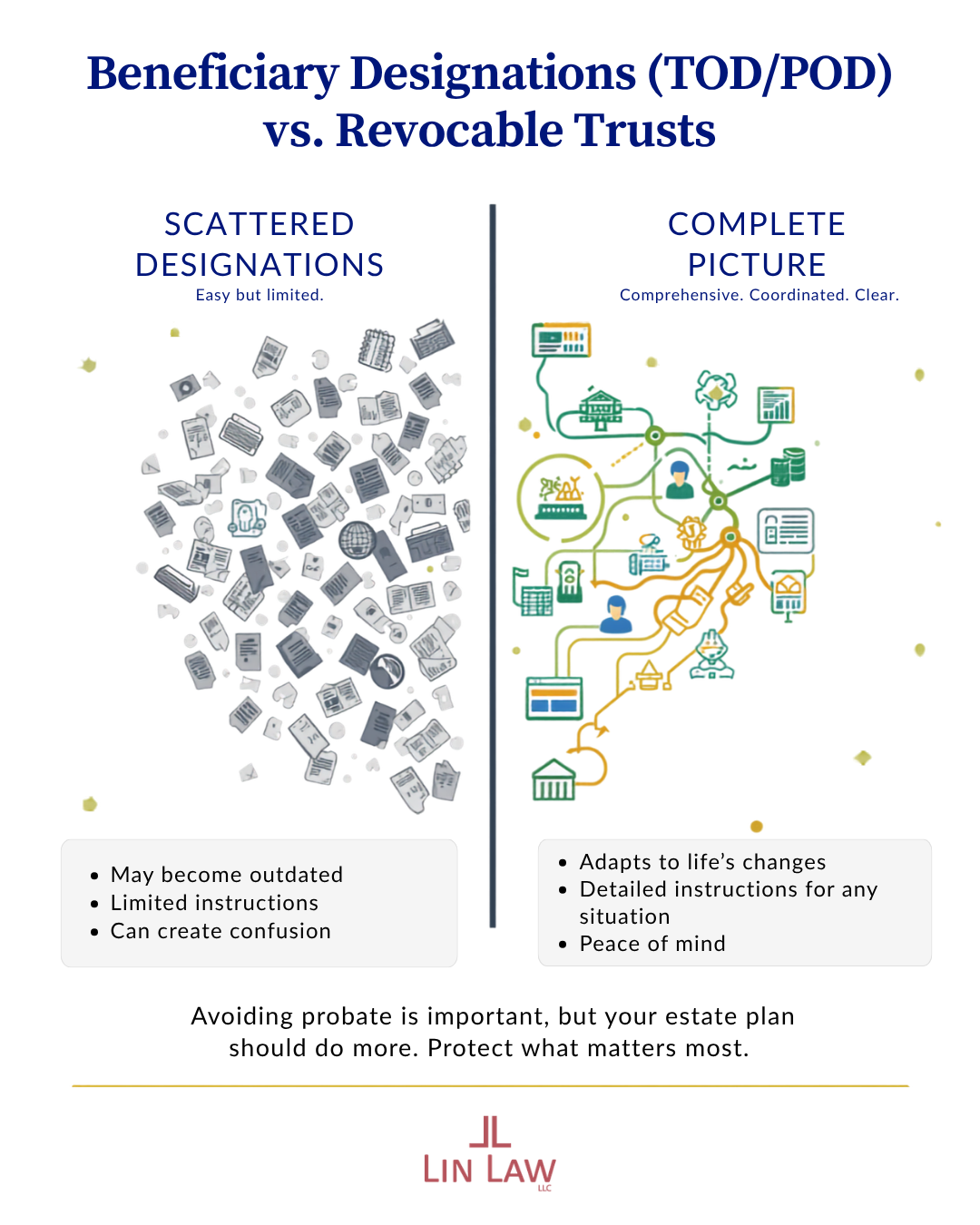
 One of the most common misconceptions about estate planning is that adding beneficiary designations to your financial accounts will be enough to both avoid probate and have a comprehensive estate plan. However, while transfer-on-death (TOD) and payable-on-death (POD) designations can help pass assets directly to your heirs without probate, a clearly structured estate plan focuses on more efficiently managing assets and their distribution, since it takes into account unforeseen life changes that a TOD or POD designation does not account for. Avoiding probate alone should not be the only goal with respect to a complete estate plan.
This is where revocable trusts can provide significant advantages. A revocable trust enables your assets to be managed as a whole—and includes instructions for distributing them in the case of unexpected circumstances. Rather than relying on multiple beneficiary designations that may become outdated or create confusion, a revocable trust provides a clear roadmap with alternative steps to account for any life changes. Although beneficiary designations can be a useful tool, a revocable trust is ultimately a more effective solution to the various complexities of asset transfers and as part of a comprehensive estate plan.
Save your family from legal complications during an already stressful time by creating a comprehensive estate plan. A thoughtful estate plan today can provide peace of mind for you and your loved ones tomorrow. Prepare for the future now to minimize headaches for your family and ensure that your wishes are honored.